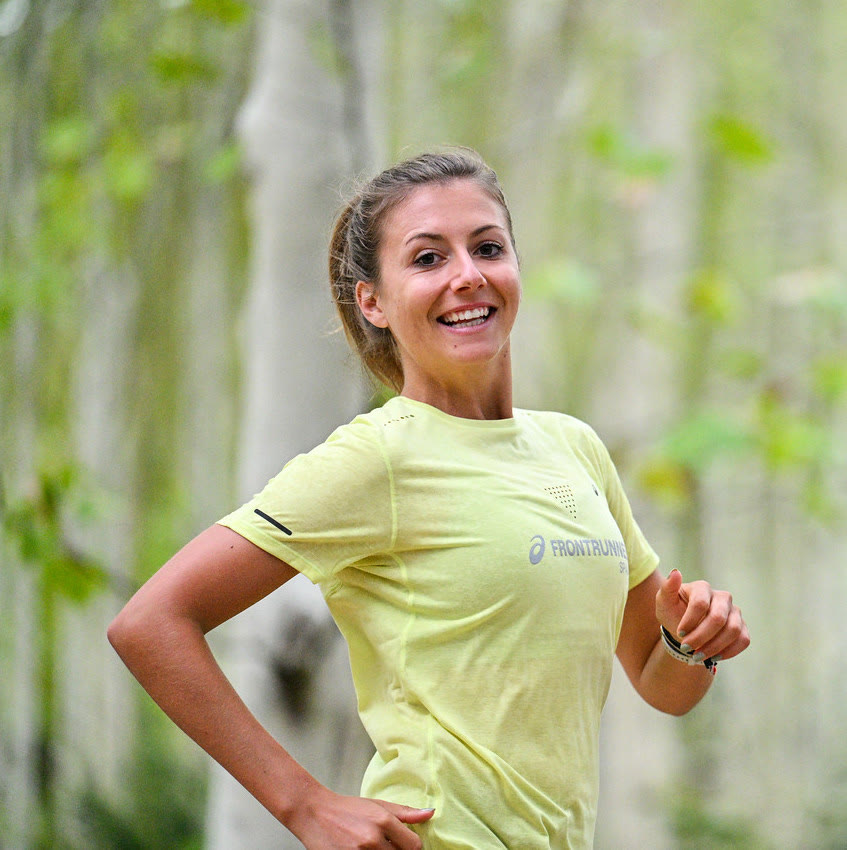
A coaching practice without a home base
Lisa Geybels runs Lis(t)a Coaching from Barcelona, though she is on the road more than she is at home. She is Belgian, she has coached online for six years, and most of the runners she trains she has never met in person. Next to the coaching she runs ultra trails herself and she is starting a mountain guide course.
Her athletes come from everywhere except, oddly enough, Spain. Around nine in ten are Belgian, the rest come from the Netherlands, Germany, Austria and the UK, and she has coached runners in Venezuela and Hong Kong. Half are men, half are women. Since a few months she also trains a company group of fifteen people who work towards the same goal on their own schedules.
Lis(t)a Coaching offers:
- One-to-one online coaching for road and trail runners, from a first 5K to ultra trail
- Plans built on her own SR5 method: load progression, recovery, strength, intensity and adaptation
- Coach-led trail running camps in Europe
- The Run Smarter app for self-coached runners
- Coaching in English, Dutch and Spanish
The Excel years
Lisa started her practice with about twenty athletes and a spreadsheet.
I was just using Excel, but it took me so much time. Make the Excel, send it to my athletes, my athletes sending it back to me, making the changes.
Every plan was a file that travelled back and forth. That holds at twenty athletes. It stops holding the moment the practice grows.
The turning point
The answer had been in front of her the whole time. The coach Lisa trained with as an athlete used Coachbox.
My coach at that point was using Coachbox. A couple of months afterwards I started my own coaching business. I remembered that she was using Coachbox, so I was like, let’s just give it a try as well.
She switched at around twenty athletes. That grew to sixty. Today she coaches about forty, a number she picked herself so she has room for the mountain guide course.
Two days a week back
Ask Lisa what changed and she answers in days of the week.
On Monday, Wednesday and Friday I look through all the training plans. That takes me a morning, three or four hours, to go through all the comments. Then on Tuesday and Thursday I have time for marketing, for sales, for finance. Normally I had to do all of those in my free hours.
Thanks to Coachbox I still have free hours even though I’m self-employed, and on top of that I also have time to train for my own events.
The feature she hands to new coaches first
Asked which single feature she would recommend to a coach starting out, Lisa does not hesitate. It is the AI workout builder.
I often just type workouts so people understand them, but then I still have to structure the workout so people can export it. Now I can type the explanation into the AI tool and it makes the workout already exportable.
She is more careful with the AI feedback, and that carefulness is worth repeating. She tried it on her own training first.
It’s always telling me to rest, that I have too much fatigue accumulated. But because of the nature of my sport I can’t back off that much, and I know my recovery is good. You can’t say the AI feedback tool is one hundred percent right and just copy paste. You really need to see what it says and then still use your common sense as a coach.
Reading recovery, not just training
Lisa takes recovery as seriously as training, and that is where the data earns its place.
Sometimes athletes say yeah yeah, I’ve recovered well, because they want to train again. Quite often the numbers are saying other things.
She leans on HRV rather than resting heart rate, because resting heart rate fluctuates too much to read a trend from. Then she puts that next to what the athlete tells her.
I try to combine them, because I also know my athletes.
One thing never shows up in a training file, and Lisa plans around it anyway. Four or five of the women she coaches add a note in Coachbox when their cycle starts, and that week becomes a rest week.
Because the hormones fluctuate, our recovery fluctuates too. Most of it is to avoid injuries.
Three things she would tell a coach starting today
Invest in good software or automation. In the beginning there is marketing, taxes, conversations, finding customers, collaborations. Find the places where you can save time.
Really invest in a good software or a very good automation, because it can save you a lot of your own energy, but also time.
Track your clients’ feedback. People trust people, not machines. When someone thanks you for an insight, screenshot it and ask permission to use it.
Don’t compare yourself. Coaching is built on trust, and trust takes longer than one year to build.
What comes next
Forty athletes, a mountain guide course and ultra trails of her own. Lisa built a practice that runs from wherever she happens to be, which is rarely the same place twice.