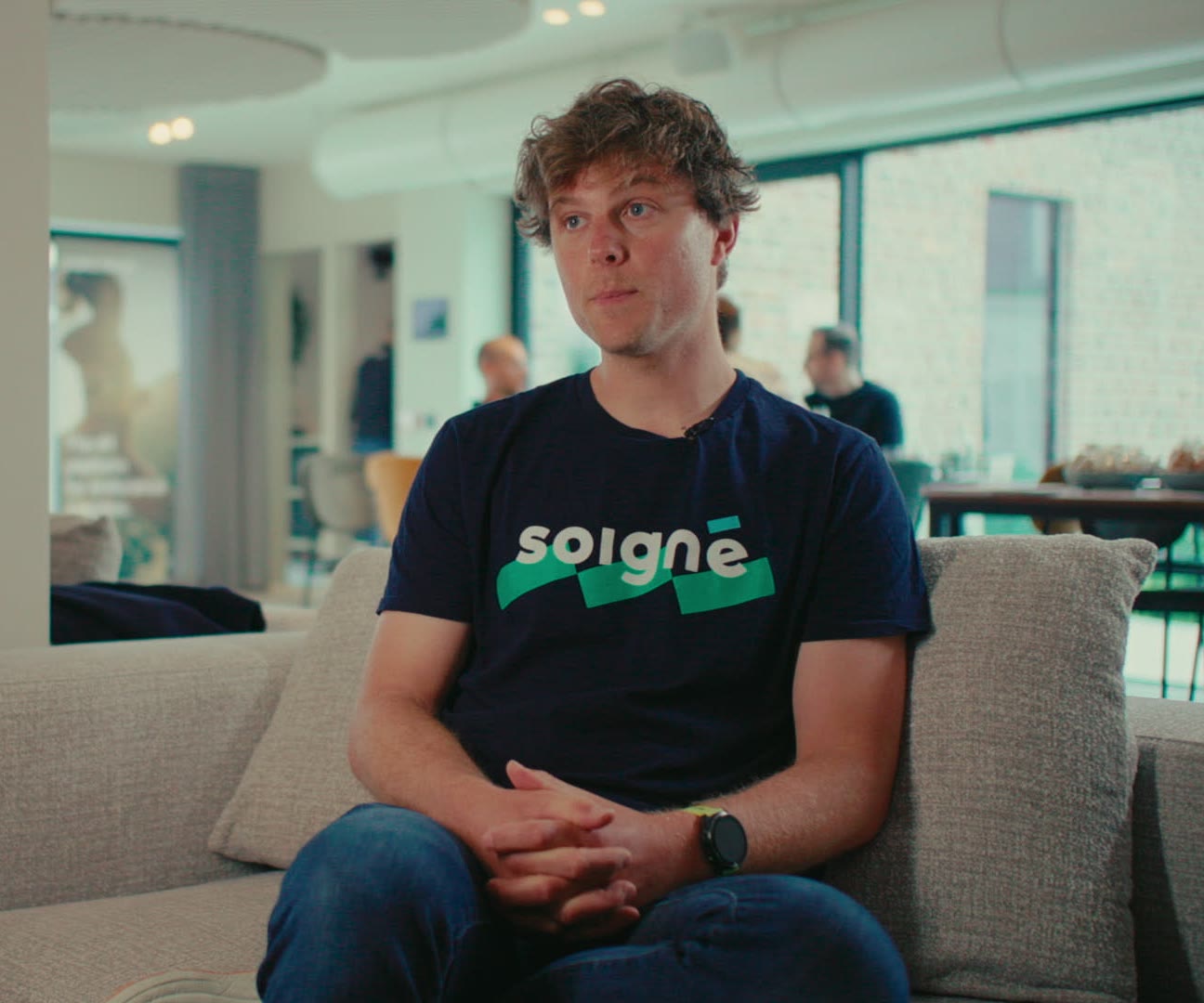
A practice that started with a back injury
Dries Béatse stopped cycling competitively because of back problems. Core stability was not a topic at the time, and that gap became his reason to coach.
My initial drive when I went to study to become a coach was that I had stopped as a cyclist with back complaints. I wanted to support other young athletes and protect them from the same mistakes I made back then.
He started ten years ago as a personal trainer, after hours, alongside his job as a gymnastics teacher, driving from one client’s home to the next. Today Soigné is a team of eleven in Ronse.
Soigné brings together:
- Physiotherapy, with four physiotherapists
- Personal training and strength coaching
- Nutritional guidance
- A screening that measures body control, strength and core stability before any programme starts
- Endurance coaching for runners, cyclists and triathletes under its own brand, Cadans by Soigné
- Lactate testing
Growing without losing what made it work
The step from one person to eleven is where most practices break. Dries is clear that the growth was never engineered.
It all grew very organically, and we are lucky to be able to select people who hold the same values as I do and that we consider important as a company. Those are the same things we hear here at Coachbox. We want to help people.
One location changed the business more than any hire. Before, logistics were the constraint, driving from client to client. Now the disciplines sit next to each other.
Now it is very easy, because within your own team you can steer easily and reach different disciplines without having to make any real effort.
The limit today is the building rather than the demand. Trainers knock on the door asking to work there, a physiotherapist joined recently, and in three to five years a bigger space is realistic. What Dries will not trade for growth is the internal dynamic he has now, or the time with his two young children.
Why they chose Coachbox
The route in ran through the team. His trainer Brecht, a triathlete, knew Ruben from the sport. After the first demo the decision was made.
What they were looking for was not the longest feature list.
It was a relatively simple system at that time, and that is what we were looking for. Something usable that does not spray data at you, because we really do not work with the pure elite athlete, but rather with the ordinary person who wants to combine work with a family and still train with quality alongside that.
That is an unusual buying criterion, and it explains the fit. Soigné coaches people whose training has to survive contact with the rest of their lives.
What I value most is how far a coach can personalise, that they can add their own touch everywhere, and that you get the support of the knowledge that sits in the system. That is a win-win.
From launch to half the time back
We showed the Coachbox AI assistant for the first time at our meetup in May 2026. Soigné was in the room. A month later we went back to Ronse to ask what had actually changed, and the answer started the morning after the event.
Brecht and I were texting each other. Did you already test it? Did you already test it? The first moment we saw the AI button appear, we immediately checked our own schedule and asked it to analyse the training we had done over the last eight weeks, just to see what the system could do.
Soigné was not new to AI. They had a tool built the year before for their own strength training method. What was new was letting it loose on endurance data, and Dries has a clear answer on what changed.
The main thing that has changed is the time we gain by using the system. The AI allows us to analyse so much more data, and in so much more depth than we could ever have done, and it is doing it in a time that is crazy. It is like having a professor or a teacher next to you all the time. You can ask questions and you do not have to rely on time to get your answer.
Asked to put a number on it, he hesitates for the right reason.
It is difficult to say how much time it saves us, because we go into so much more depth thanks to the system, so it delivers much more quality to the athletes we coach at the moment. But you could easily say that you gain 50% of the time.
The point worth holding onto is the one he makes first. The time did not go into doing the same work faster. It went into work they were not doing at all before.
The three questions they ask most
Soigné uses the assistant athlete by athlete rather than across the roster, and three uses come back.
A training readiness check before a hard block.
We ask the AI to check the HRV and the morning heart rate. If the athlete has a big endurance block or a high intensity block coming, we want to see whether they are really ready for it. That saves a lot of time, because you do not have to work it out yourself.
A second opinion on their own programming. They put the plan for the coming weeks in front of it and ask for feedback on anything worth changing.
A zone audit over a whole period.
When we are doing a build-up and we want the athlete specifically in zone 2, we ask for a quick check over those eight or twelve weeks. How much time is this athlete spending in that specific zone? These are questions we get answered in a matter of, not even minutes.
Next to that sits the AI workout builder, and for Soigné it removes a specific chore.
Clients always ask for the segments so they can export them to their watch and it tells them during the session what to do. That was quite time consuming to build as a coach. I think it is one of the biggest time gains with the new AI build.
Why the memory matters
Dries has used enough AI tools to know what usually goes wrong, and he points at memory as the difference.
I think this is one of the most important strengths of the Coachbox AI, that it has a memory. It always knows who the client is. Knowing who your client is is one of the most important aspects of coaching, so the fact that it can save that information and keep it in mind for future questions is one of the most important things for delivering quality.
They feed it deliberately. Intake forms go in, test results from Coachbox go in, and the brain is told to keep it all in account.
If you use all the components available in Coachbox, the year plan, when the races are, you see the AI building it and it says now I am checking heart rates, now I am checking the year plan, now I am checking the races. With all that information it gives you a better answer. So as a coach you have to use all the other components in Coachbox to get the best answer out of the AI.
He reports no hallucinations, and he credits his own team for part of that.
We are very used to using AI, so my coaches know how to feed it. They know how to ask the questions. That is why from the beginning we had good answers.
What he would tell another owner
Three things come back in his answers. Dare to invest and dare to jump. Go looking for knowledge other people have already gathered and are willing to share. And use AI properly as an assistant rather than opening a chat window and typing at it.
He puts retention above acquisition, in the team and with clients alike.
Instead of always focusing on hiring new people, we also focus on the ones you already have, so retention stays high.
Asked what he would say to a coach not yet using the AI assistant, he does not hedge.
That they must definitely use it. We have used other software in the past and we were very happy to see the AI development in Coachbox. AI is everywhere, but you have to use it in the right way. I think Coachbox really nailed it with the AI component, and I do not know any other software that uses it this way.
I am very proud of how we have done it. The whole road we travelled grew very organically. I do not think there is anything I would really do differently.