

For over a century, maximal oxygen uptake (VO2max) has served as the gold standard for measuring human oxidative capacity. Yet an athlete’s physiological identity is governed by three metabolic pathways, not one: oxidative phosphorylation, the breakdown of phosphocreatine and glycolysis.
While VO2max defines the maximal aerobic power, vLamax quantifies glycolytic power and carbohydrate flux. In this blog post we will focus on three main questions:
- Why should we care about vLamax?
- How can I increase or decrease vLamax?
- How can I measure vLamax?
Let’s dive into it.
Why should we care about vLamax?
The short answer is, because vLamax gives you a more complete picture of the athlete’s physiological profile. It’s a unique piece of information that clarifies:
- Why some athletes use more carbohydrate during exercise than others
- Why some athletes have an extra gear for sprints and accelerations
- Why some athletes can sustain a high percentage of VO2max for hours, while others crash in minutes
But how does this work? Is a high vLamax always a performance benefit?
Without going down the rabbit hole of muscle metabolism, it is important to understand that our metabolic pathways operate in synchronisation. This can be observed in the graph below, showing lactate production (red curve, the result of glycolysis) and lactate oxidation (blue curve, the result of aerobic metabolism) in relation to the exercise intensity (X-axis). As exercise intensity ramps up, the energy systems become more active. This is logical: at higher intensities, more energy is needed and this should be produced at once. It’s important to note that the behaviour of glycolysis is different compared to aerobic metabolism: glycolysis ramps up following an exponential pattern, whereas aerobic metabolism behaves rather on a (quasi) linear trajectory (Mader, 1984, 1999, 2003). Where both curves cross, the exercise intensity is identified where lactate production equals lactate oxidation. This is the so-called maximal lactate steady state (MLSS, aka anaerobic threshold). Below MLSS, lactate production is relatively low and the aerobic metabolism can keep up to oxidise this lactate. Above MLSS, lactate is produced at a fast rate and saturates aerobic metabolism. Such efforts are called “non-steady-state” efforts, as all physiological parameters evolve to extreme values and fatigue will set in quickly.
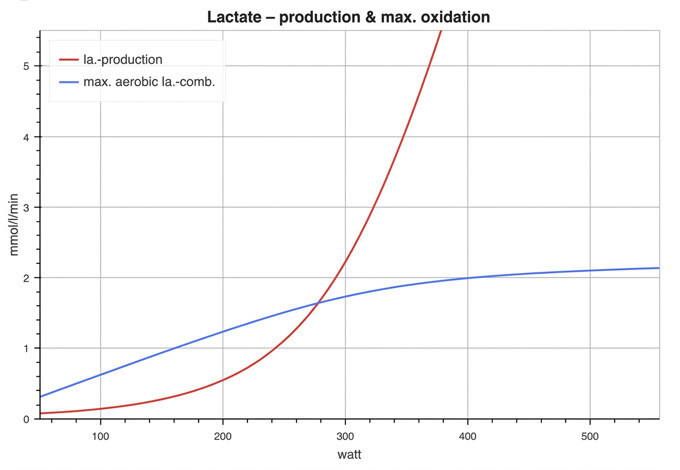
Figure 1: Lactate production (glycolysis) and lactate oxidation (aerobic metabolism).
Athletes with a high vLamax have steeper “lactate production” curves. This means that they will use carbohydrates at a faster rate and have a lower MLSS (the crossing point shifts to the left) at a lower %VO2max. But also, a high vLamax means a powerful glycolytic system, which allows fast energy production: perfect for sprints and accelerations.
The opposite is true for athletes with a low vLamax: less carbohydrate utilisation, lower lactate production, higher MLSS… and lower sprinting power.
Some typical vLamax values can be found in table 1.
| Athletic population | Typical reference values for vLamax (mmol/l/s) |
|---|---|
| Middle distance running | 0.5-0.7 |
| Road cycling, one-day classics | 0.5-0.7 |
| Road cycling, GC grand tours | 0.3-0.4 |
| Track cycling, sprint | 0.8-1.0 |
| Long distance triathlon | 0.2-0.3 |
Table 1: Typical values for vLamax (mmol/l/s) in different athletic populations. Values for male athletes. Female athletes have in general slightly lower values.
How can I increase or decrease vLamax?
As far as I know, only one study has been published that investigated the effect of endurance training (ET) and sprint interval training (SIT) on vLamax (Hommel et al., 2019). Thirty participants were randomly assigned to the SIT, ET or control group (n = 10 each). Each session consisted of four to six repetitions of 30 s all-out Wingate anaerobic tests (SIT) or 60 min cycling at 1.5 to 2.5 mmol/L blood lactate (ET). Both groups trained three days per week, over a period of six weeks.
The results of this study were somewhat surprising: the SIT group decreased vLamax and increased VO2max and MLSS, whereas the ET group increased VO2max and MLSS without affecting vLamax. SIT did not increase vLamax. One explanation for this observation is that the sprints were too long and the rest intervals too short to create a specific stimulus for the glycolytic energy system. Indeed, the energy contribution from aerobic metabolism increases with sprint duration and incomplete rest between efforts. The SIT appeared to be an effective aerobic stimulus, and ineffective to improve vLamax.
Of course, we should be careful to draw general conclusions from just one study. More research is needed to better understand what type of exercise can impact vLamax and what mechanisms are behind the observed adaptations.
Despite the lack of scientific evidence, there’s some knowledge from the coaching community. Of course, this should be taken with a grain of salt. Also, the training response can be different in athletes with different vLamax values. Athletes with a high vLamax might need very specific stimuli to further increase vLamax (see the results of the study by Hommel and co-workers), whereas athletes with a low vLamax will experience a meaningful glycolytic stimulus at much lower exercise intensities.
I’ve summarised this in table 2.
| Training to increase vLamax | Training to decrease vLamax |
|---|---|
| Short sprints (10-15 s), long rests (5-15 min) | High-volume, moderate-intensity training |
| Strength training, 10-20 repetitions per set | Sweetspot training |
| MLSS training | |
| Low cadence training |
Table 2: Training systems to increase or decrease vLamax, based on information from the coaching community.
How can I measure vLamax?
Despite its growing presence in modern performance coaching, there’s not yet a scientific consensus or gold standard on how vLamax should be tested. Probably the most common approach is to establish vLamax from the increase in blood lactate concentration over the sprint duration. This approach originated from scientific work by Sebastian Weber, using very specific test conditions such as ergometer settings (Weber, 2003).
vLamax = (Lamax − Larest) / (texercise − talactic)
Traditional vLamax testing using sprint efforts has suffered from methodological flaws, mathematical over-corrections and conceptual confusion (Wackerhage et al., 2025). The authors highlight six fundamental methodological flaws, such as the difficulty of assessing the energy contribution from the phosphagen and oxidative pathways, that make measuring true maximal glycolysis in human subjects from sprint efforts virtually impossible. To obtain a ballpark number for the athlete’s vLamax, the sprint approach is still a usable method.
To overcome these methodological difficulties in sprint tests and to obtain a more accurate vLamax, a Swiss-based company developed a mathematical model to derive vLamax from submaximal efforts. In the absence of a gold standard, their mathematical approach has not yet been validated in a head-to-head comparison. But more and more case studies (Ohr & Lindschulten, 2023; Robberechts et al., 2023, 2024; Van Schuylenbergh, 2024) and validation studies using their mathematical model are published in scientific papers (Podlogar et al., 2022; Poffé et al., 2024; Van Schuylenbergh et al., 2026). This can be seen as an indirect validation of the calculations.
To wrap it up
vLamax is a fundamental element of the athlete’s physiological profile. It provides deeper insight into the athlete’s metabolism and physiological performance. vLamax can be measured using sprints, to obtain a ballpark number, or with specific mathematical models. Today, we can build on the experience of the coaching community to design specific training programmes to optimise vLamax. More research is needed to clarify what type of training creates specific stimuli to either increase or decrease vLamax.
References
- Hommel, J., Öhmichen, S., Rudolph, U. M., Hauser, T., & Schulz, H. (2019). Effects of six-week sprint interval or endurance training on calculated power in maximal lactate steady state. Biology of Sport, 36(1), 47-54. https://doi.org/10.5114/biolsport.2018.78906
- Mader, A. (1984). Eine Theorie zur Berechnung der Dynamik und des steady state von Phosphorylierungszustand und Stoffwechselaktivitaet der Muskelzelle als Folge des Energiebedarfs. Deutsche Sporthochschule Köln. BISp.
- Mader, A. (1999). Anaerobic threshold (AT) as determined by VO2max and vLamax of the working muscle mass of the human body: an update of the theoretical concept. 14.
- Mader, A. (2003). Glycolysis and oxidative phosphorylation as a function of cytosolic phosphorylation state and power output of the muscle cell. European Journal of Applied Physiology, 88(4), 317-338. https://doi.org/10.1007/s00421-002-0676-3
- Ohr, C., & Lindschulten, R. (2023). Load intensity determination in long-distance triathlon with INSCYD athletic performance software. Sport Performance & Science Reports, 196. https://sportperfsci.com/load-intensity-determination-in-long-distance-triathlon-with-inscyd-athletic-performance-software/
- Podlogar, T., Cirnski, S., Bokal, Š., & Kogoj, T. (2022). Utility of INSCYD athletic performance software to determine Maximal Lactate Steady State and Maximal Oxygen Uptake in cyclists. Journal of Science and Cycling, 11(1), 30-38. https://doi.org/10.28985/1322.jsc.06
- Poffé, C., Van Dael, K., & Van Schuylenbergh, R. (2024). INSCYD physiological performance software is valid to determine the maximal lactate steady state in male and female cyclists. Frontiers in Sports and Active Living, 6, 1376876. https://doi.org/10.3389/fspor.2024.1376876
- Robberechts, R., Poffé, C., & Van Schuylenbergh, R. (2023). Calculated glycolytic power and substrate utilization during a world record marathon in a female runner. Sport Performance & Science Reports, 209. https://sportperfsci.com/calculated-glycolytic-power-and-substrate-utilization-during-a-world-record-marathon-in-a-female-runner/
- Robberechts, R., Poffé, C., & Van Schuylenbergh, R. (2024). Calculation of the metabolic demands of a successful cycling world-hour record by a validated mathematical model. Sport Performance & Science Reports, 244.
- Van Schuylenbergh, R. (2024). Can a world class junior cyclist beat a multiple Tour de France winner? Sport Performance & Science Reports, June(226).
- Van Schuylenbergh, R., Khurshudyan, A., & Weber, S. (2026). Validity of the calculated VO2max from cycling power and vLamax. International Journal of Sports Science and Physical Education, 11(1), 1-10. https://doi.org/10.11648/j.ijsspe.20261101.11
- Wackerhage, H., Kabasakalis, A., Seiler, S., & Heck, H. (2025). Is the vLamax for Glycolysis What the VO2max is for Oxidative Phosphorylation? Sports Medicine, 55(8), 1853-1866. https://doi.org/10.1007/s40279-025-02259-6
- Weber, S. (2003). Calculation of performance-determining parameters of metabolic activity at the cellular level by means of cycle ergometry [Berechnung leistungsbestimmender Parameter der metabolischen Aktivität auf zellulärer Ebene mittels fahrradergometrischer Untersuchungen]. Diploma thesis, Deutsche Sporthochschule Köln.