

VO2max reflects the maximum amount of oxygen per unit of time a person can consume during exercise. It is a measure of the maximum cardiorespiratory power, also called aerobic power.
Importance of VO2max
In everyday life
In health research, VO2max is monitored in the context of physical fitness, longevity and healthy ageing. A high VO2max has a protective effect against diseases such as cardiovascular disease. Conversely, people with a very low VO2max are at increased risk of these diseases and are more likely to be in need of help (Schumacher et al, 2023). Exercise and aerobic training can slow down the decline in VO2max due to ageing (Valenzuela et al, 2020).
In sports
The aerobic energy system is dominant in all sports with an exercise duration of approximately 60 seconds or longer. A strong aerobic energy system therefore allows you to produce a lot of energy, and this is directly related to maximum performance in endurance sports such as running, cycling, cross-country skiing, triathlon, swimming, ball sports or rowing.
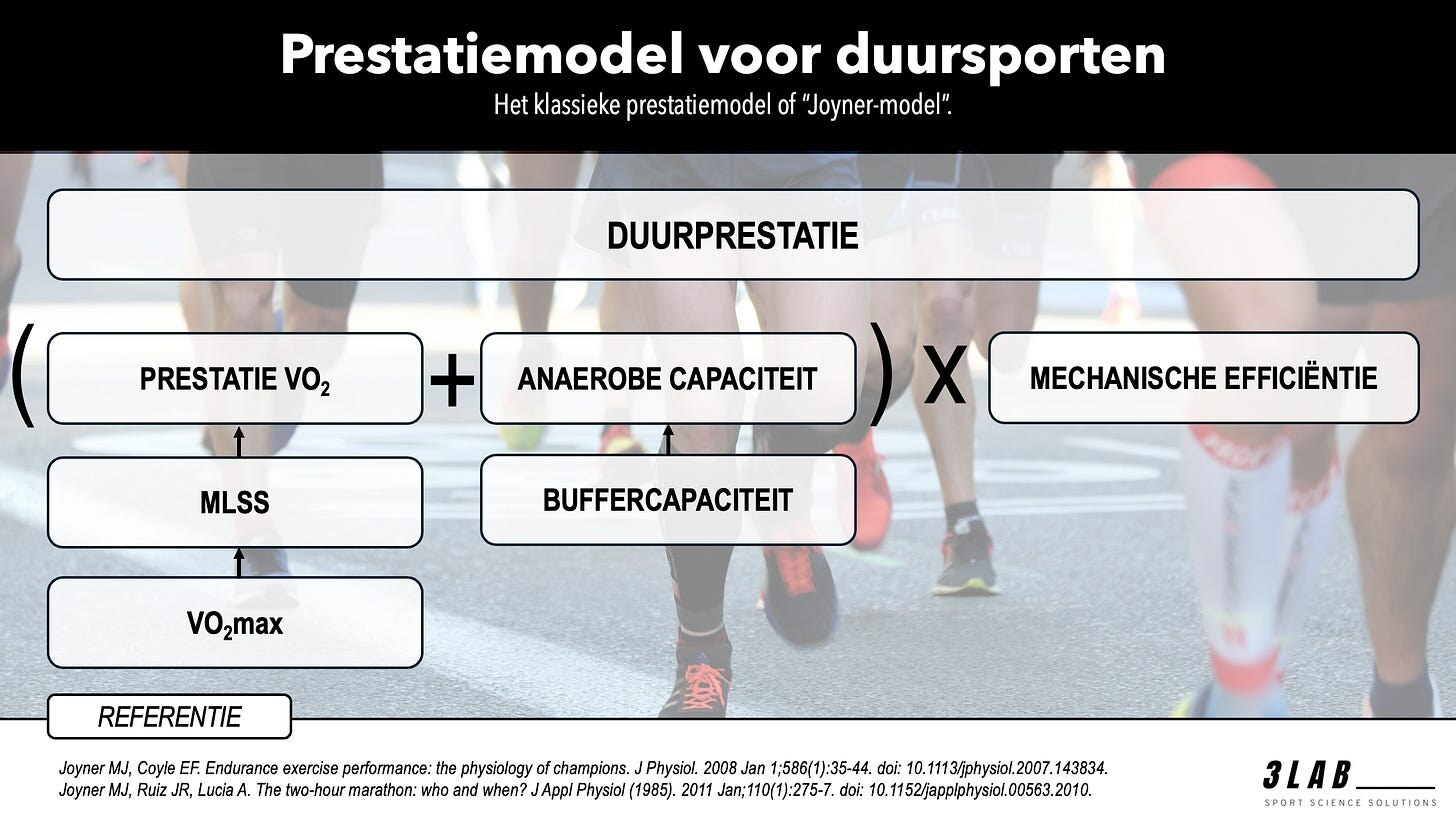
The classic performance model for endurance sports, the Joyner model. Source: 3LAB (figure in Dutch).
A second important aspect for the athlete is that a strong aerobic system accelerates recovery after intensive efforts. After all, it is in the aerobic energy system that the depleted PCr reserves can be replenished, lactate can be used as a fuel and muscular acidosis (H+) can be restored.
To assess individual VO2max values, reference standards can be used, see the table below. However, in top sport we notice that elite performers have even higher scores, up to more than 85 ml/min/kg for men and more than 70 ml/min/kg for women in sports such as cycling, swimming, distance running, triathlon or cross-country skiing.
| VO2max | Level 2, physically active | Level 3, trained | Level 4, well-trained | Level 5, elite |
|---|---|---|---|---|
| Female | 37-48 | 48-52 | 52-58 | > 58 |
| Male | 45-55 | 55-65 | 65-71 | > 71 |
Standards for a sporting population (18-35 years), in ml/min/kg.
The highest VO2max value published in the scientific literature is 96.7 ml/min/kg, measured in a junior cyclist (Rønnestad et al, 2019).
Gold standard
Traditionally, VO2max is determined from an incremental maximum exercise protocol of 5 to 15 minutes, in which the breathing gases (VO2 and VCO2) are measured during exercise.
VO2max is determined to be the highest average oxygen demand for 15 to 30 seconds during such a maximum test protocol. To ensure that the highest value has been achieved, the following criteria are applied.
Primary: no increase in VO2 despite the increasing workload, the VO2 plateau.
Secondary: when no VO2 plateau is established and a true VO2max is not observed, the following criteria are used to assume VO2max has been reached, when two or more of them are met:
- RQ > 1.10
- HR > 90% of predicted maximum heart rate
- [Lactate] > 8 mmol/L
- RPE > 18/20
Ideally, a retest is provided after such a test to confirm the result.
The accuracy of this methodology is ±2 mL O2/min/kg. This means that the method lacks the sensitivity to detect small changes in VO2max.
Alternatives
Measuring VO2max requires trained personnel and specific equipment such as a metabolic cart. This equipment is also very expensive and requires regular calibration and maintenance. That makes the gold standard procedure difficult to use in training practice. Many researchers therefore investigated more practical and affordable methods.
Statistical models
A first approach to this problem is to describe a statistical relationship (correlation) between a practical measurement on the one hand and VO2max on the other. Such studies then describe a regression or statistical relationship between both variables and allow you to calculate VO2max. It is important to note that such statistical models are valid only for the tested procedures and population, and cannot be applied in different contexts.
Sitko and colleagues investigated the relationship between a 5 minute maximum time trial and VO2max in well-trained cyclists. The correlation, the measure of the relationship between two variables, was 0.61. This means that the model can predict approximately 37% of the variability in VO2max from the 5 minute power test. This model is probably useful to observe group tendencies in groups of competitive cyclists, but is insufficiently accurate to detect change at the level of the individual.
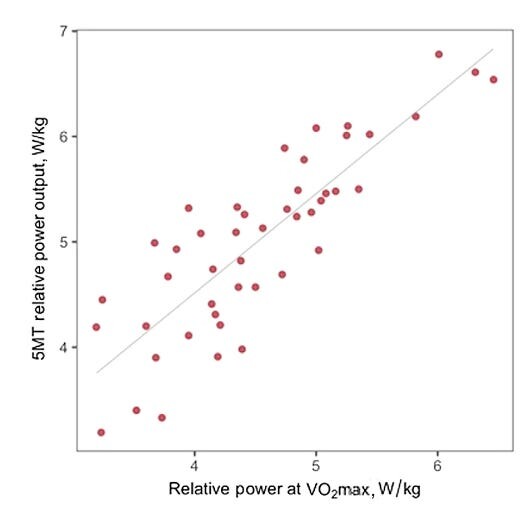
Relative power output in a 5 minute maximum time trial plotted against relative power at VO2max (Sitko et al, 2022).
A similar approach exists for running, where VO2max is predicted from a 3 km maximum running performance (Daniels 1992).
These statistical models have the advantage of simplicity. However, the relationships found are specific to the sample studied and to the investigated testing procedures. Cross-validation studies, in which the regression model is applied to a new sample, have rarely been done. Such models also do not provide insight into the cause of a difference in the measured VO2max result.
INSCYD model
A few years ago, new software was launched on the market to determine the metabolic profile of the athlete. INSCYD’s calculations are built on evolutions of mechanistic models of muscle metabolism and cardiopulmonary kinetics, which to a great extent originated from published as well as unpublished work from Prof Dr Alois Mader.
Cross-validation studies demonstrated a strong association (0.95 < r < 0.98) and a minimal difference between the calculated and the measured physiological parameters, VO2max and MLSS (Podlogar et al, 2022; Poffé et al, 2024; Van Schuylenbergh et al, 2026). This model appears to provide valid results comparable with gold standard test procedures. An important advantage of this model is that the metabolic profile can be derived from training or testing data, without the need for expensive testing equipment.
Conclusions
- VO2max remains the reference measurement to map physical fitness and aerobic capacity.
- The gold standard measurement method requires expensive technology and experienced operators.
- Statistical models can be used to monitor VO2max at group level, but lack the accuracy to monitor the individual.
References
- Daniels J, Daniels N. Running economy of elite male and elite female runners. Med Sci Sports Exerc. 1992 Apr;24(4):483-9.
- Mader A. Glycolysis and oxidative phosphorylation as a function of cytosolic phosphorylation state and power output of the muscle cell. Eur J Appl Physiol. 2003 Jan;88(4-5):317-38.
- Millet, G. P., Burtscher, J., Bourdillon, N., Manferdelli, G., Burtscher, M., & Sandbakk, Ø. (2023). The VO2max Legacy of Hill and Lupton (1923), 100 Years On. International Journal of Sports Physiology and Performance, 18(11), 1362-1365. https://doi.org/10.1123/ijspp.2023-0229
- Podlogar T et al (2022). Utility of INSCYD athletic performance software to determine Maximal Lactate Steady State and Maximal Oxygen Uptake in cyclists. Journal of Science in Cycling.
- Poffé C, Van Dael K, Van Schuylenbergh R. INSCYD physiological performance software is valid to determine the maximal lactate steady state in male and female cyclists. Front Sports Act Living. 2024 May 7;6:1376876.
- Rønnestad BR, Hansen J, Stensløkken L, Joyner MJ, Lundby C. Case Studies in Physiology: Temporal changes in determinants of aerobic performance in individual going from alpine skier to world junior champion time trial cyclist. J Appl Physiol (1985). 2019 Aug 1;127(2):306-311.
- Schumacher B, et al. Validation, Recalibration, and Predictive Accuracy of Published VO2max Prediction Equations for Adults Ages 50-96 Yr. Medicine & Science in Sports & Exercise 55(2):p 322-332, February 2023.
- Sitko, S., Cirer-Sastre, R., Corbi, F., & López-Laval, I. (2022). Five-Minute Power-Based Test to Predict Maximal Oxygen Consumption in Road Cycling. International Journal of Sports Physiology and Performance, 17(1), 9-15. https://doi.org/10.1123/ijspp.2020-0923
- Valenzuela, P.L., Maffiuletti, N.A., Joyner, M.J. et al. Lifelong Endurance Exercise as a Countermeasure Against Age-Related Decline: Physiological Overview and Insights from Masters Athletes. Sports Med 50, 703-716 (2020). https://doi.org/10.1007/s40279-019-01252-0
- Van Schuylenbergh, R., Khurshudyan, A., Weber, S. (2026). Validity of the Calculated VO2max from Cycling Power and VLamax. International Journal of Sports Science and Physical Education, 11(1), 1-10. https://doi.org/10.11648/j.ijsspe.20261101.11