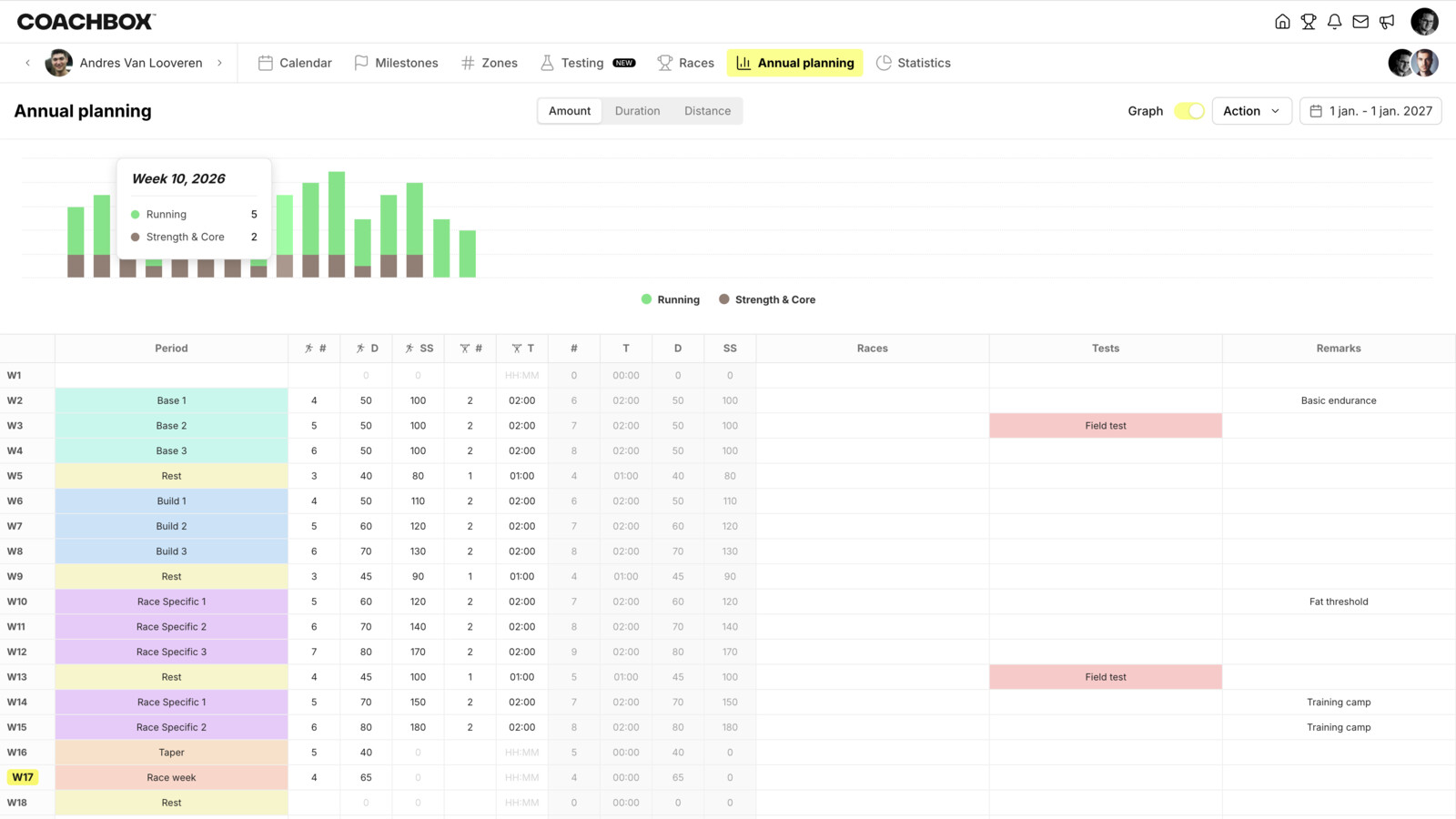
Many endurance athletes train hard but without direction. They follow the same weekly structure, grab a random interval workout off the internet, or build volume without an end goal. The result: stagnation, chronic fatigue, or peaks at the wrong moment. The fix doesn’t start with a better workout, it starts with better planning. Specifically, a macro-plan.
What is a macro-plan?
A macro-plan, also called an annual plan or season plan, is the overarching training plan that structures your entire season. It sits at the top of the planning hierarchy every coach and serious athlete works with:
- Macro-planning covers the full season or year (6-12 months). It defines when you move through each training phase and when you peak for your key races.
- Meso-planning covers a training block of 3-6 weeks with a specific goal, such as building your aerobic base or sharpening your threshold.
- Micro-planning is the weekly plan: the concrete split between workouts, rest and intensity within a week.
Without a macro-plan, the meso- and micro-plans lack direction. You can write perfect interval sessions, but if they land at the wrong point in the season, they won’t deliver the result you’re after.
Why every serious athlete needs an annual plan
The human body adapts through progressive overload. That only works if you systematically alternate between building up and recovering, between volume and intensity. A macro-plan forces you to think ahead and make choices.
The trap many athletes fall into is the “always training, never progressing” cycle. They do moderately intense sessions all year round, with no real peaks or valleys. The body gets used to that load and stops adapting. A structured annual plan prevents this by deliberately alternating periods of high load with periods of recovery and build-up.
A macro-plan also helps you set priorities. Not every race can be a main goal. By deciding in advance where your season is heading, you can say no to distractions with more confidence, and deliberately underperform at less important events along the way.
The building blocks of a season plan
Setting goals: A, B and C races
Every good macro-plan starts at the end: your main goals. In endurance sports, races typically fall into three categories:
- A-races are your absolute main goals. Plan a maximum of two or three per season, and your whole periodization is built around peaking for them. Think a spring race and a fall event, with enough time between to build up again.
- B-races matter, but you don’t fundamentally reshape your plan around them. They ideally fall in a build phase and serve as a good test or preparation for an A-race.
- C-races are training-focused events. You do them for the experience, the fun or the stimulus, without tapering or recovering for them.
For a cyclist that might look like this: a spring classic as the first A-race in April, a stage race in July as the second A-race, and a fall race as a possible third peak. A triathlete might plan a half distance in June and a full Ironman in September. A runner works toward a spring marathon in April and a fall marathon in October.
Periodization models
There are several ways to structure your season. The right choice depends on your sport, your experience and your race calendar.
Linear (classic) periodization is the most common model. You start with high volume and low intensity, then gradually shift toward lower volume and higher intensity as the race approaches. This model works well for athletes with one or two clear peaks per season, such as marathon runners or triathletes building toward an Ironman.
Reverse periodization flips that order: you start with intensity and add volume later. It’s sometimes used in cycling when winter training happens on the indoor trainer. Short, intense sessions suit indoor training better, and volume grows once the weather allows for outdoor rides.
Block periodization concentrates specific training types into short, focused blocks of two to four weeks. One block focuses purely on aerobic base, the next on threshold, the third on VO2max work. This model is popular among experienced athletes who already have a broad fitness base and need targeted stimuli to keep progressing.
The training phases in detail
A typical season moves through the following phases:
Off-season / transition period (2-4 weeks)
After the last race block of the season comes a period of active recovery. This isn’t a full stop, but a period of sharply reduced volume and no structured intensity. Alternative activities like swimming, hiking or mountain biking keep the engine running without the mental and physical load of sport-specific training. This period is essential for long-term progress.
Base phase (12-16 weeks)
The base phase is the foundation of your season. The focus is on aerobic capacity: long, low-intensity workouts (zone 1-2), combined with strength training and technique work. In cycling this means long rides at a comfortable pace. For runners it’s easy mileage with an occasional tempo run. Triathletes split volume across three disciplines, with extra attention to their weakest one.
It’s tempting to skip or shorten this phase, but that catches up with you later in the season. A strong aerobic base means your body handles more intense training better and recovers faster between efforts.
Build phase (8-12 weeks)
In the build phase, the balance shifts toward intensity. Threshold sessions, sweet spot work and longer tempo intervals become a fixed part of the weekly program. Total volume stays stable or drops slightly, while training load rises through the higher intensity.
For a cyclist, a typical week in the build phase might look like this: two intense sessions (say, sweet spot intervals on Tuesday and a threshold ride on Thursday), a longer endurance ride on the weekend, and two to three recovery rides. A runner combines tempo runs with track intervals and a long run.
Specialization phase (4-6 weeks)
Training now becomes race-specific. A cyclist preparing for a hilly race does more climbing work. A triathlete plans brick sessions (cycling directly followed by running) to train the transitions between disciplines. A marathon runner trains at race pace over progressively longer distances.
Volume gradually drops, but the intensity of key sessions stays high. The focus shifts from building fitness to sharpening race-specific capacity.
Taper (1-3 weeks)
During the taper you reduce training load so your body can fully recover and supercompensation kicks in. Volume drops by 40-60%, but the intensity of remaining sessions stays high. That way you keep your sharpness without adding extra fatigue.
Taper length depends on the event. For a marathon or Ironman, two to three weeks is typical. For a shorter race, a week may be enough. Training less often feels uncomfortable, but this is exactly the moment when the adaptations from the past months show up.
Race period and recovery
After your A-race comes a recovery period of at least a week, depending on how demanding the event was. After an Ironman, two to three weeks is not unusual. This recovery isn’t optional: it’s an investment in the next build cycle.
The recovery week pattern
Within every phase, one principle matters: the recovery week. Most athletes use a rhythm of three weeks of building followed by a recovery week (3:1), or two weeks of building and a recovery week (2:1) for older athletes or under high training load.
During a recovery week, you reduce volume by 30-40% compared to the previous week. Intensity can stay in the form of short openers or strides, but total work is significantly lower. This gives your body the chance to actually realize the training adaptations.
Skipping recovery weeks is one of the fastest routes to overtraining. The body doesn’t get stronger during the training itself, but during the recovery afterward.
Sport-specific considerations
Cycling
The cycling calendar dictates much of the periodization. Spring brings classics and crits, summer brings stage races and mountain races, fall wraps up with kermesses or cyclocross. The shift from indoor training (on the trainer) to outdoor rides in spring is a critical moment: volume suddenly rises through longer rides, while intensity drops. Plan that transition deliberately into your macro-plan.
Triathlon
Balancing three disciplines makes macro-planning more complex. A common approach is to give one discipline extra attention per mesocycle while the other two stay at maintenance level. Brick sessions (the combination of cycling and running) become increasingly important in the specialization phase. Total volume needs to stay manageable: three good sessions beat five mediocre ones.
Running
In marathon prep, the long run is the anchor point of the weekly plan. A classic build-up runs from 25 kilometers to 32-35 kilometers over 12-16 weeks, with recovery weeks every three to four weeks where the long run is shorter. The marathon taper typically starts two to three weeks before the race, halving weekly volume while keeping interval sessions sharp.
Common mistakes
Too much intensity, too early. It’s tempting to start January with full-on interval training, but without a solid aerobic base you lack the foundation to absorb that intensity. Short-term gains cost you long-term progress.
Skipping the off-season. Athletes who train year-round without a mental and physical reset eventually burn out. Two to four weeks a year without structure isn’t wasted time, it’s an investment.
Skipping or shortening the base phase. Twelve weeks of zone 2 riding doesn’t feel spectacular, but it lays the groundwork for everything that follows. Athletes who have the patience for a solid base phase reap the benefits all season.
Treating every race as an A-race. Athletes who taper and recover for every race never get around to actually training. Learn to distinguish between races that matter and races that are part of the training.
How tooling makes the difference
Building a macro-plan on paper or in a spreadsheet is a start, but it quickly becomes unmanageable once the season progresses and adjustments are needed. A shifted race, an injury or an unexpectedly strong training block all demand flexibility in your plan.
Platforms like Coachbox with built-in annual planning functionality help coaches and athletes map out the macro-plan visually, define training phases and adjust the plan throughout the season. Linking it to daily training data shows you not just what you planned, but how execution compares to the plan. That’s the difference between a static document and a living planning tool.
Final thoughts
A macro-plan isn’t a rigid blueprint you draw up in October and follow blindly until September. It’s a guiding framework that helps you do the right training at the right moment. The power isn’t in the plan itself, but in the thinking behind it: knowing where you’re headed, which phases you’ll move through, and when to deliberately ease off so you can push harder later.
Start with your A-races, work backward to the training phases, respect the recovery weeks, and have the patience to let the base phase do its job. Athletes who plan their season with a well-thought-out macro-plan don’t just show up fitter on race day, they show up with more confidence too.
The Coachbox Academy offers practical modules on periodization and season planning, so you learn how to build a macro-plan and adjust it to the reality of your athletes.